

During October, CIDAUT actively participated in two major events in the Spanish energy sector: the 18th International Bioenergy Congress and the 5th Renewable Gas Exhibition in Valladolid (October 1–2), and the RH2EDIN Congress in Algeciras (October 28–29). As the H2METAMO project reaches its conclusion in December, these events offered excellent opportunities to showcase its results and reinforce its contribution to the development of renewable hydrogen and synthetic gases.
International Bioenergy Congress and Renewable Gas Exhibition – Valladolid
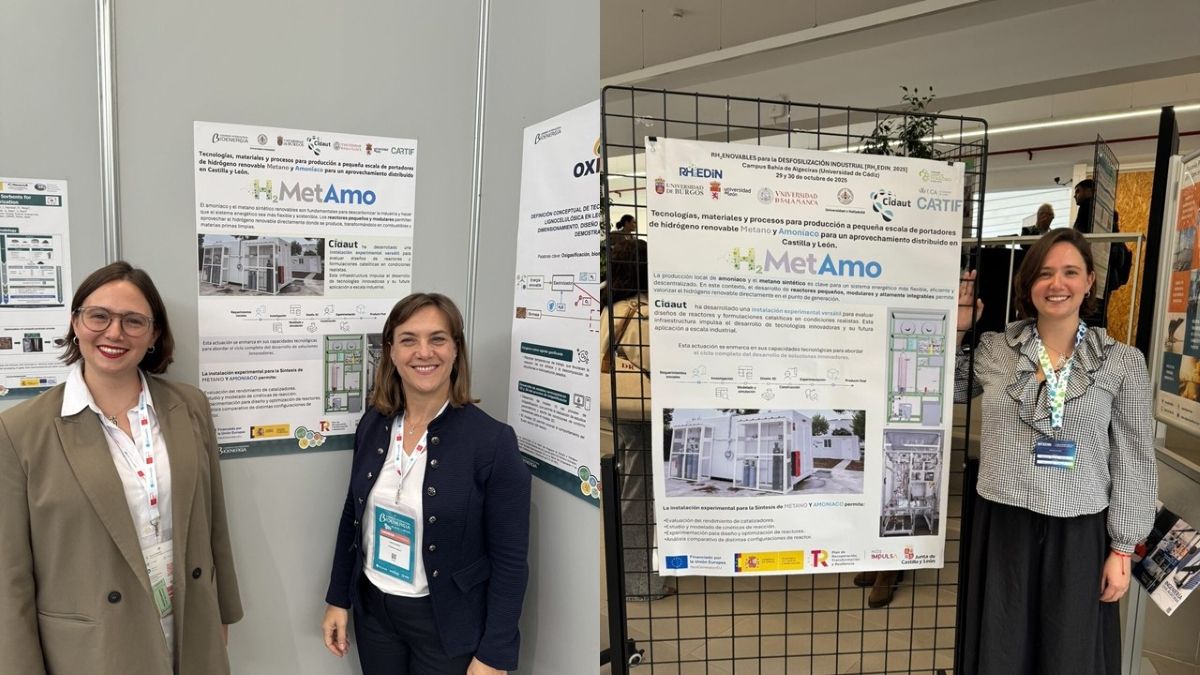
At the International Bioenergy Congress, CIDAUT presented the poster “Synthesis of Renewable Methane and Ammonia in Advanced Reactors: Results from the H2METAMO Project”, represented by Aldana Regina Chini and Henar Olmedo Gómez. The poster showcased the development of an experimental bench designed to evaluate different reactor designs and catalytic beds for renewable methane and ammonia production.
Additionally, Aldana Regina Chini presented a short video introducing the H2METAMO project, explaining how the team is developing new processes, reactors, and catalysts (such as ruthenium) to produce key energy carriers more efficiently and with lower energy consumption. The experimental bench allows testing at a smaller, modular scale, suitable for decentralized installations, for example in synergy with agro-industrial facilities.
The project also highlighted the use of CO₂ from biogas upgrading (~40%), combined with hydrogen produced via electrolysis using renewable energy, as feedstock for methane synthesis. This approach contributes to the integration of biomethane into the gas grid, enhancing Spain’s energy autonomy and resilience.
The ultimate goal of H2METAMO is to transfer this technology to industry and accelerate real decarbonization in Castilla y León and beyond. The video can be viewed here: Watch on YouTube
RH2EDIN Congress – Algeciras
The RH2EDIN Congress, organized by the University of Cádiz and the Fundación Campus Tecnológico de Algeciras, focused on renewable hydrogen technologies and industrial decarbonization. CIDAUT again presented the H2METAMO poster, with Aldana Regina Chini representing the Energy Department, and participated in oral presentations on e-fuels and methanation processes, as well as in the moderation of sessions on hydrogen, CO₂ conversion, and sustainable fuels.
The event provided an opportunity to disseminate technical advances to researchers, companies, and energy sector stakeholders, generate synergies with key actors, and strengthen H2METAMO’s positioning as a strategic project for the distributed production of hydrogen carriers.
Significance of the H2METAMO Project
H2METAMO aims to transform the production, storage, and use of renewable hydrogen through its conversion into renewable methane and ammonia. This enables decentralized production of clean energy carriers, flexibility in managing renewable energy surpluses, and the use of biogenic CO₂, contributing to a circular carbon economy and greater integration of renewable gases into the grid and industry.
This approach helps democratize access to clean energy and accelerates the transition towards a sustainable and resilient energy model.
