

Once again, CIDAUT took part in the National Congress on R&D in Defense and Security (DESEI+D) to present its latest advances in dual-use technologies, reinforcing the centre’s long-standing commitment to innovation with applicability in both civilian and military domains.
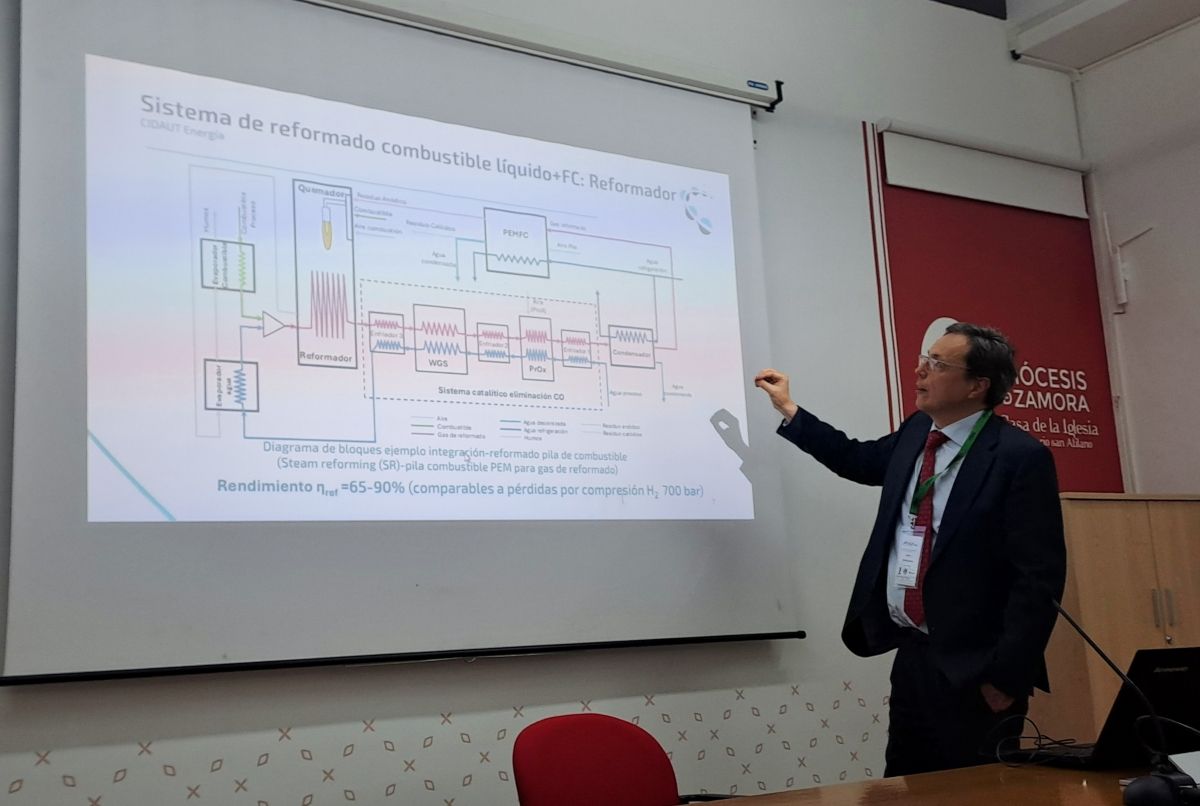
The 12th edition of DESEI+D was held in Zamora from 11 to 13 November 2025. During the event, Alfonso Horrillo, Head of CIDAUT’s Energy Department, delivered a presentation entitled “On-board integration of reforming processes and fuel cell in military applications.” In his talk, he outlined the strategic relevance of fuel-cell and battery hybrid propulsion systems for defense applications, particularly due to their silent operation, reduced thermal signature, and potential for enhanced operational autonomy.
The presentation highlighted a key challenge: while conventional propulsion systems based on internal combustion engines benefit from compact storage of high-volatility liquid fuels, hydrogen storage for fuel-cell applications still requires significantly larger volumes and weights. In land vehicles, hydrogen is typically stored in tanks pressurised at 350–700 bar, which introduces technical complexities and still results in gravimetric and volumetric energy densities 10 to 20 times lower than those of traditional liquid fuels. As a result, vehicles requiring high power output and/or long driving ranges face substantial limitations when relying solely on compressed hydrogen storage.
To address these constraints, CIDAUT is exploring on-board reforming technologies as an alternative. Storing a liquid fuel and converting it on demand into hydrogen—or into a hydrogen-rich gas mixture suitable for fuel-cell operation—offers a promising solution. This approach maintains the discretion advantages of electric propulsion while enabling greater energy autonomy. Similar concepts are already being implemented in advanced submarine propulsion systems equipped with third-generation AIP (Air Independent Propulsion) units.
CIDAUT’s participation in DESEI+D25 demonstrates the centre’s active role in advancing discreet, efficient and sustainable propulsion technologies with dual-use potential. These developments contribute not only to future military capabilities but also to civilian applications requiring low-emission, noise-reduced and energy-efficient mobility solutions.