


The ProtAct-Us project, funded by the European Union under the Horizon Europe Programme, aims to improve the protection of all road users against severe injuries and their long-term physical, cognitive, and psychological consequences. The three-year project brings together 13 European partners from industry and research in the fields of medicine and vehicle safety. By combining medical and engineering expertise, ProtAct-Us develops effective and robust protective solutions for a wide range of road users, from pedestrians to occupants of passenger transport systems.
ProtAct-Us project is currently at half time and already set the bases for creating the basis for enabling working towards full project results in the technical work packages. In short, ProtAct-Us provides the following:
- Analysis and Review of Existing Injury Data and availability data on serious injuries and long-term consequences for the targeted road user groups.
- Development of ProtAct-Us Assessment concept for long-term consequences of road crashes.
- Identification of relevant use cases and crash scenarios for the different road user categories.
- Relevant use cases and crash scenarios for the various road user categories are focus on:
- Pedestrians: Head and thorax injuries for adults and children, internal organs, lower extremities
- Occupant Passenger Cars: Head and thorax injuries for children. Various injuries in all body regions for adults
- VRUs (Motorcycles, Bicycles, New Mobility Devices): Children and adults, Head injuries (skull & facial fractures, brain injuries)
- Occupants of Passenger Transport Systems (Bus, Shuttle): Various injuries in all body regions for adults

CIDAUT leads the Pedestrian road user group and contributes to occupant protection in passenger cars, with a particular focus on child safety. A comprehensive review of available accident data for both cases was conducted, and—given the limited understanding of long-term injury mechanisms in children— an extensive literature review was undertaken to strengthen the knowledge base on paediatric injuries.
Two virtual test matrices were defined, incorporating a range of crash load cases representative of potential car-to-pedestrian and car-to-car conflict scenarios, with the aim of identifying the most critical conditions. Simulations were performed using human body models (HBMs) for pedestrian cases involving adult male, adult female, and 6-year-old child models, as well as for child occupants in passenger vehicles subjected to side-impact loading.
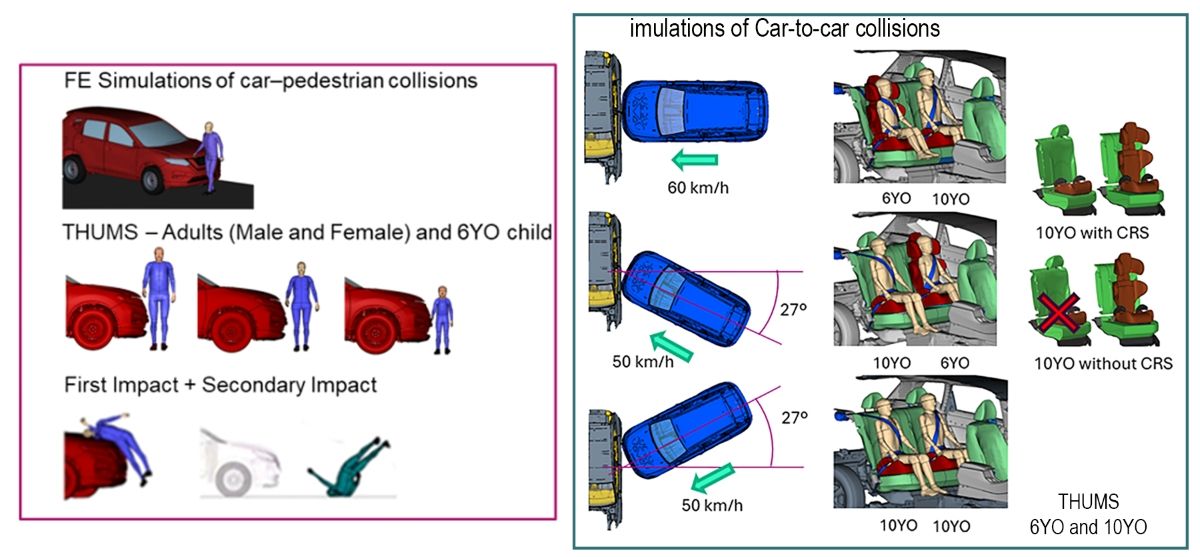
For pedestrian configurations, both the primary vehicle impact and the subsequent ground contact were taken into account. In the occupant scenarios, 6- and 10-year-old child models were positioned in different rear-seat configurations to capture potential occupant–occupant interactions. Based on the simulation outcomes, the most critical use cases were identified and prioritised for further investigation, within which targeted countermeasure concepts were subsequently developed and proposed.

Further information about the project can be found at https://protact-us.eu/