


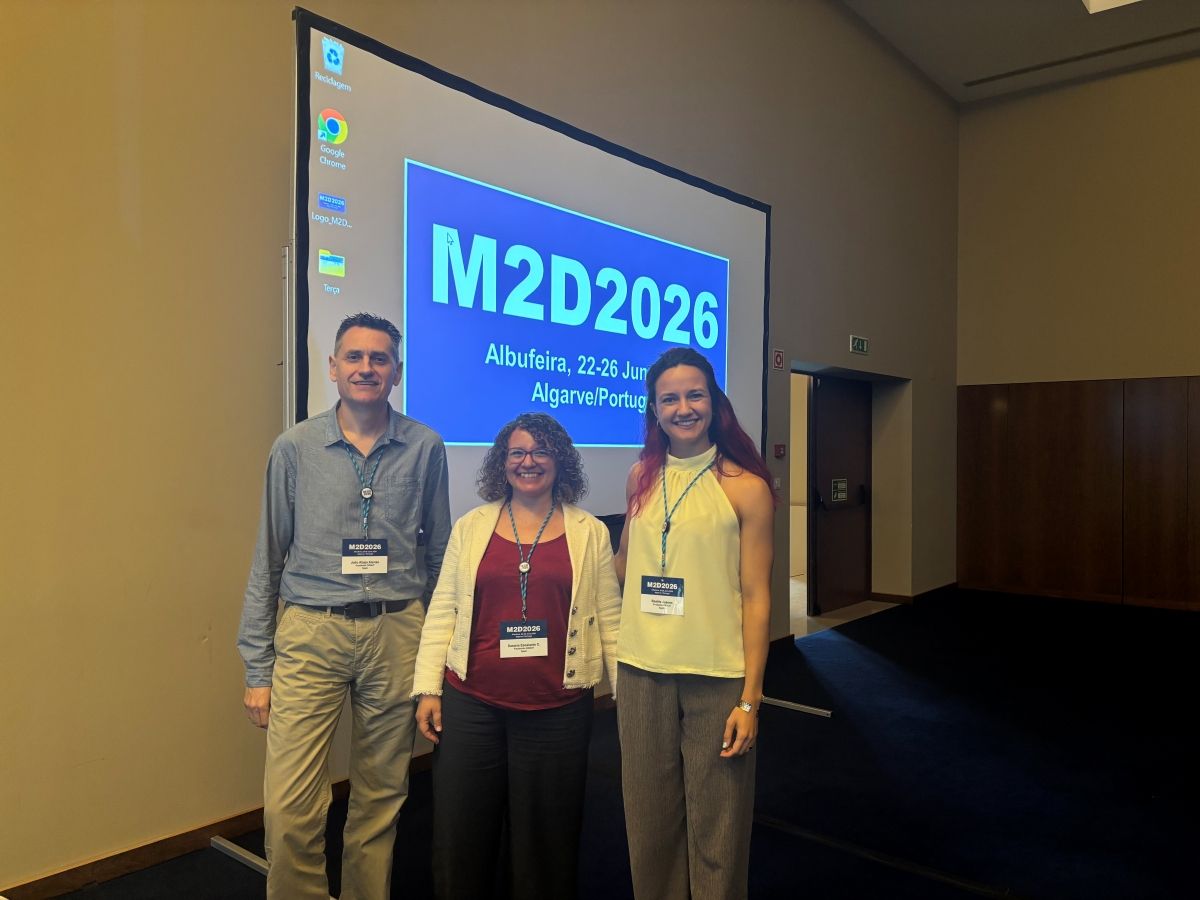
From June 23rd to 25th, CIDAUT participated in the M2D2026 International Conference on Mechanics and Materials in Design (M2D2026), held in the Algarve region of Portugal. The conference, supported by leading institutions including the Faculty of Engineering of the University of Porto (FEUP), the Multidisciplinary Design and Analysis Laboratory of the University of Toronto (MADL), and APAET, brought together researchers, engineers and industry professionals to discuss the latest advances in mechanics, materials engineering and design methodologies. The event provided an excellent opportunity to share recent research developments and strengthen scientific exchange within the international research community.
During the conference, three CIDAUT researchers delivered oral presentations within the Automotive Engineering scope, focused on advanced methodologies for vehicle safety assessment and crash analysis. The first contribution, “Data-Driven Prediction of Head Clearance in Sled Crash Testing”, explored the application of data-driven approaches to predict occupant kinematics and head clearance during sled impact tests, supporting the development of more efficient validation and design processes in passive safety.
The second presentation, “Posture- and Sex-Dependent Injury Risk Assessment in Side Impacts Using Human Body Models”, addressed the influence of occupant characteristics such as posture and sex on injury risk in side-impact scenarios. The study employed advanced human body models to improve the understanding of injury mechanisms and contribute to more inclusive vehicle safety assessment methodologies.
The third contribution, “Methodological Challenges in Integrated Pre-Crash and Crash Assessment of Passive Vehicle Safety”, examined the challenges associated with combining pre-crash and crash-phase analyses within a unified assessment framework. The work highlighted the importance of integrating occupant behaviour prior to impact with traditional crashworthiness evaluation in order to achieve a more comprehensive understanding of vehicle safety performance.
The presentation of these three studies reflects CIDAUT’s ongoing commitment to advancing research in passive vehicle safety through the development of innovative methodologies, numerical modelling techniques and data-driven approaches. Participation in M2D2026 also provided an opportunity to exchange knowledge with international experts working in mechanics, materials and automotive engineering, while showcasing CIDAUT’s latest research activities in the field of transportation safety.