


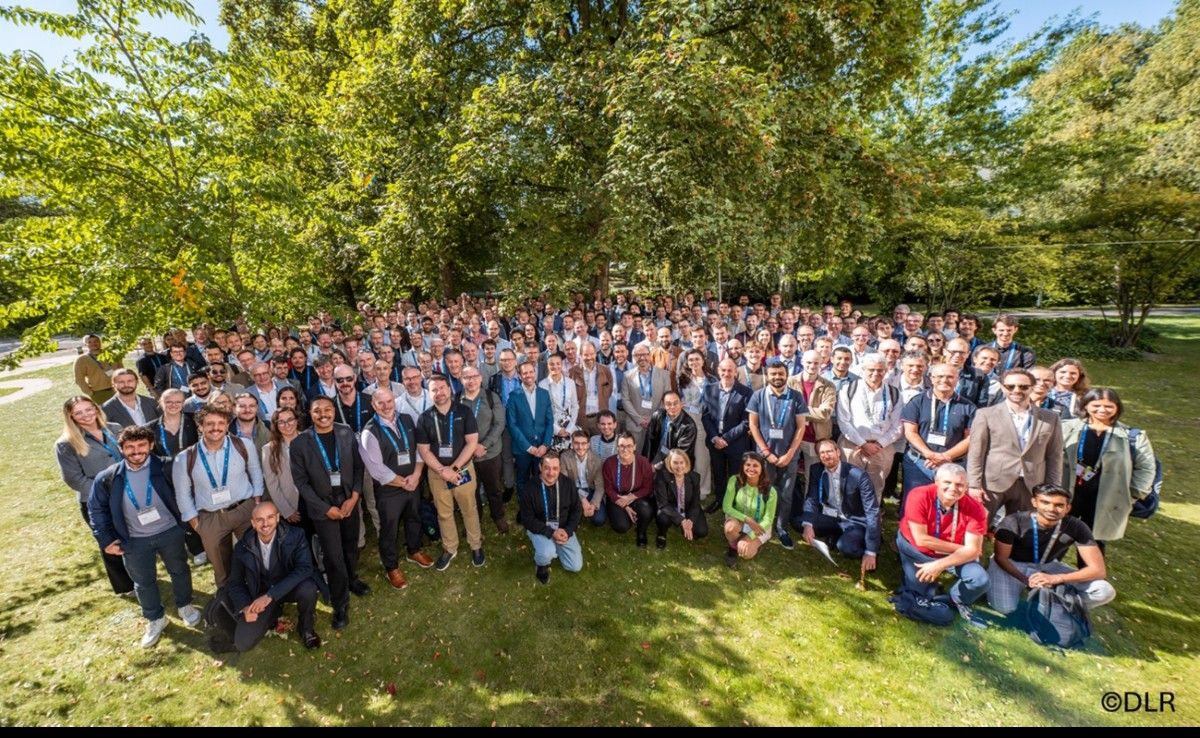
From 21 to 25 September, CIDAUT participated in ECSSMET 2026 – the European Conference on Spacecraft Structures, Materials and Environmental Testing, held in Braunschweig, Germany. Co-organised by ESA, DLR and CNES, ECSSMET is a major European meeting point for specialists working on spacecraft structures, advanced materials and environmental testing, bringing together researchers and engineers from the space industry and scientific community.
Held every two years, the conference provides an important forum to discuss emerging technologies and engineering challenges throughout the development, manufacturing, integration and verification of space systems. Topics range from structural design and advanced materials to innovative manufacturing techniques, structural dynamics and new approaches to environmental testing.
At this edition, CIDAUT presented the work “Physics-Informed Machine Learning for Thermoplastic Induction Heating of CFRP Structures in Space Applications”, focused on improving the predictability of induction heating for carbon-fibre thermoplastic composites. These materials are particularly attractive for future spacecraft structures because their combination of low weight and weldability can facilitate automated manufacturing, assembly and potentially even repair or joining operations in space.
One of the challenges of induction heating is achieving the right temperature reliably. The electrical and thermal behaviour of carbon-fibre laminates is highly dependent on their architecture and thickness, meaning that relatively small variations can significantly change how heat is generated and distributed. Conventional high-fidelity numerical simulations can provide valuable physical insight, but they are computationally expensive and do not always reproduce the experimental behaviour with sufficient accuracy.
To address this challenge, CIDAUT developed a hybrid approach combining experimental data, physics-based simulation and machine learning. This makes it possible to predict the thermal response more accurately and efficiently, while retaining the physical understanding of the process.
This research contributes to making thermoplastic composite manufacturing more reliable, efficient and easier to optimise, reducing the need for extensive trial-and-error during process development. In the longer term, this type of approach could support more automated and adaptable manufacturing strategies for future space structures.
CIDAUT’s participation in ECSSMET 2026 offered an opportunity to share these developments with the European space engineering community and to contribute to the discussion on how advanced simulation, experimental testing and artificial intelligence can work together to support more efficient and reliable manufacturing technologies for the next generation of spacecraft structures.