


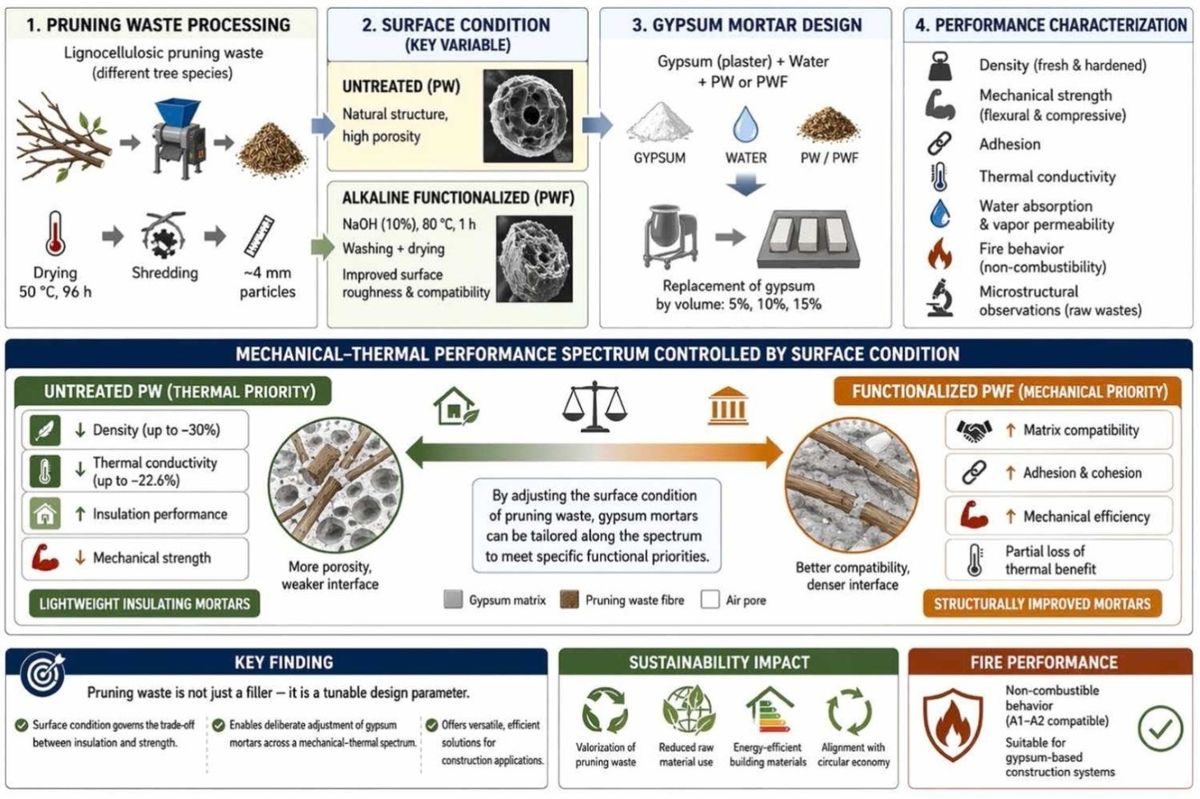
The Research Group in Building Engineering at the University of Burgos and the Materials–Product–Processes Department at CIDAUT continue to strengthen their collaboration in the development of more sustainable and circular materials for the construction sector. As a result of this collaboration and the research carried out within the MA2TEC project, “Complementary Plan in Advanced Materials» supported by MICIN and the Regional Government of Castilla y León, a new scientific article entitled “Mechanical-thermal performance of gypsum mortars incorporating untreated and alkaline-functionalized pruning waste” has recently been published in Industrial Crops & Products, a Q1 international scientific journal.
This investigation explores the valorisation of pruning waste as a secondary raw material for gypsum-based construction materials, providing an alternative pathway for a widely available residual biomass. Rather than considering pruning residues solely as waste, the research investigates their potential to become a functional component of new construction materials. Two approaches were evaluated: the direct incorporation of untreated pruning waste and the use of pruning waste functionalised through an alkaline treatment. This chemical treatment modifies the biomass and its interaction with the gypsum matrix, making it possible to evaluate how biomass functionalisation can influence the performance of the resulting composite material. The developed mortars were characterised with particular emphasis on their mechanical and thermal properties. This research studies the relationship between waste incorporation, material performance and thermal behaviour, which is particularly relevant when developing construction solutions that must combine adequate mechanical properties with enhanced thermal insulation.
From an industrial perspective, the work demonstrates the potential of using locally available biomass residues as alternative raw materials in gypsum-based products, opening opportunities to reduce dependence on conventional resources while creating added value from agricultural and urban green waste. The results also highlight the importance of surface treatment and biomass–matrix compatibility when designing bio-based construction composites with targeted properties. Overall, this research provides further knowledge for the development of a new generation of resource-efficient and circular construction materials, connecting waste valorisation with material performance and potential industrial application.