

- The COMANDO Network of Excellence, which achieved the highest technical score awarded by CDTI under the Cervera Program, will strengthen Spain’s technological sovereignty in autonomous systems for defense and security.
- The objective is to increase the maturity of autonomous vehicles so they can operate in a coordinated manner across land, sea, and air domains, both for civilian applications and for defense and security.
- The initiative is expected to generate an economic impact of €61 million through 60 business partnerships.
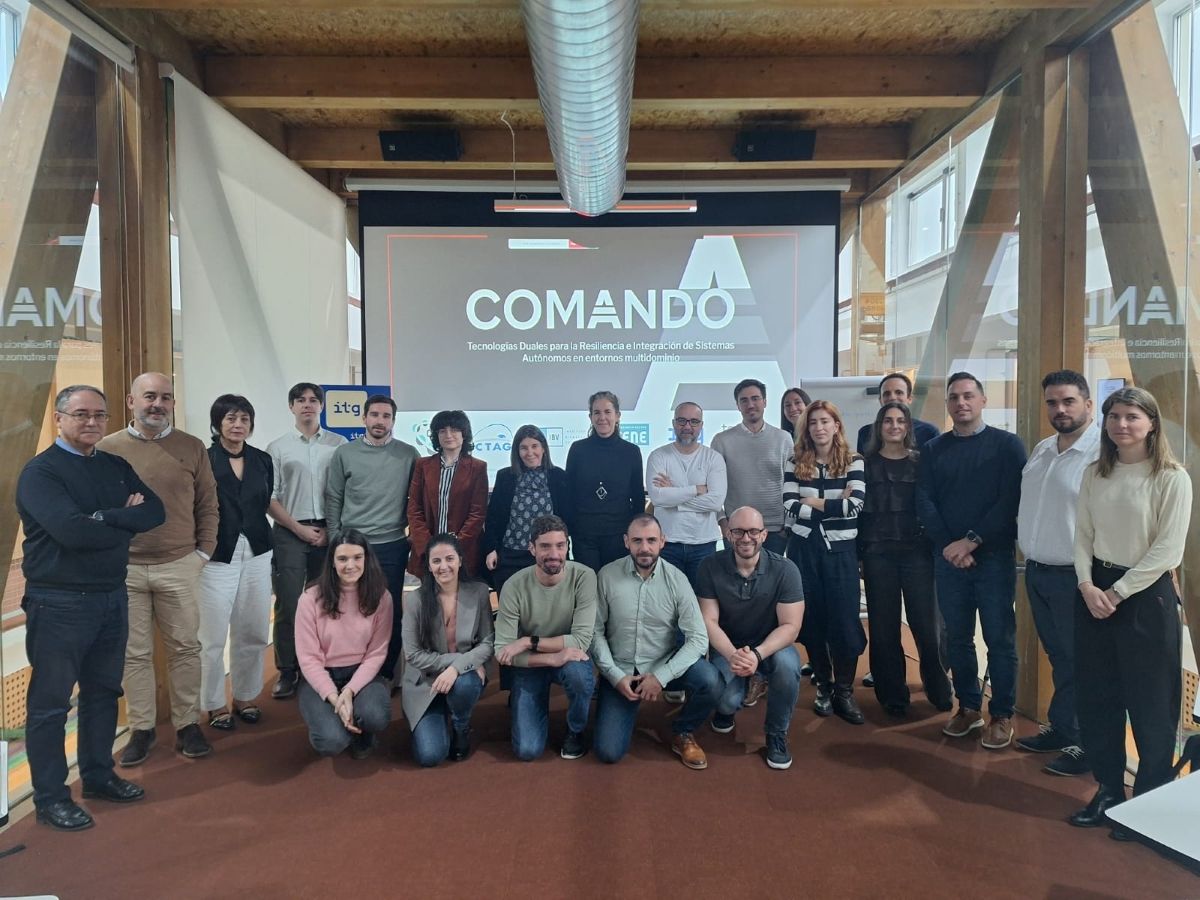
On March 5, 2026, the kick-off meeting of the COMANDO Project took place in La Coruña. COMANDO is the Spanish Cervera Research Network of Excellence focused on developing technologies for the coordination of autonomous vehicles operating in the air, on land, and at sea. Having obtained the highest technical score from CDTI (92.5 out of 100), the project is now beginning its activities with the goal of advancing systems capable of operating autonomously and cooperatively in complex environments.
The COMANDO project includes the participation of CIDAUT (Castilla y León), CTAG (Galicia), IBV and ITENE (Comunidad Valenciana), and TECNALIA (País Vasco), and is being coordinated by ITG (Galicia). Together, these organizations will work on developing solutions for the coordination of autonomous vehicle fleets.
The initiative will also establish a Defense and Security Advisory Board, composed of representatives from the Armed Forces, the Directorate General for Armament and Materiel (DGAM), and companies from the sector. This board will help guide developments to facilitate their practical application in both defense-related and civilian contexts.
The project focuses on the development of multimodal autonomous mobility systems capable of coordinating aerial vehicles (UAVs), ground vehicles (UGVs), and maritime vehicles (USVs). The objective is to increase the maturity of these technologies so they can move and operate in a coordinated manner even in demanding or hostile environments and under limited communication conditions, both in civilian settings and in defense and security applications. In this context, the network aims to strengthen national technological sovereignty by developing critical capabilities in autonomous systems. Among its goals is the validation of at least 20 technological subsystems in challenging environments and at high technology readiness levels, a key step toward future operational deployment.
CIDAUT participates in all project activities and leads Activity 3: Onboard Autonomy and Cyber-Resilience, which has just begun and will continue until the end of the project. The objective is to investigate solutions that enable autonomous platforms to operate independently, react autonomously to unforeseen situations, and withstand degradation attempts or cyberattacks.
Project CER-20251029, recognized as a CERVERA Network of Excellence, is funded by the Spanish Ministry of Science, Innovation and Universities through the Centre for the Development of Industrial Technology and Innovation (CDTI E.P.E.).
