

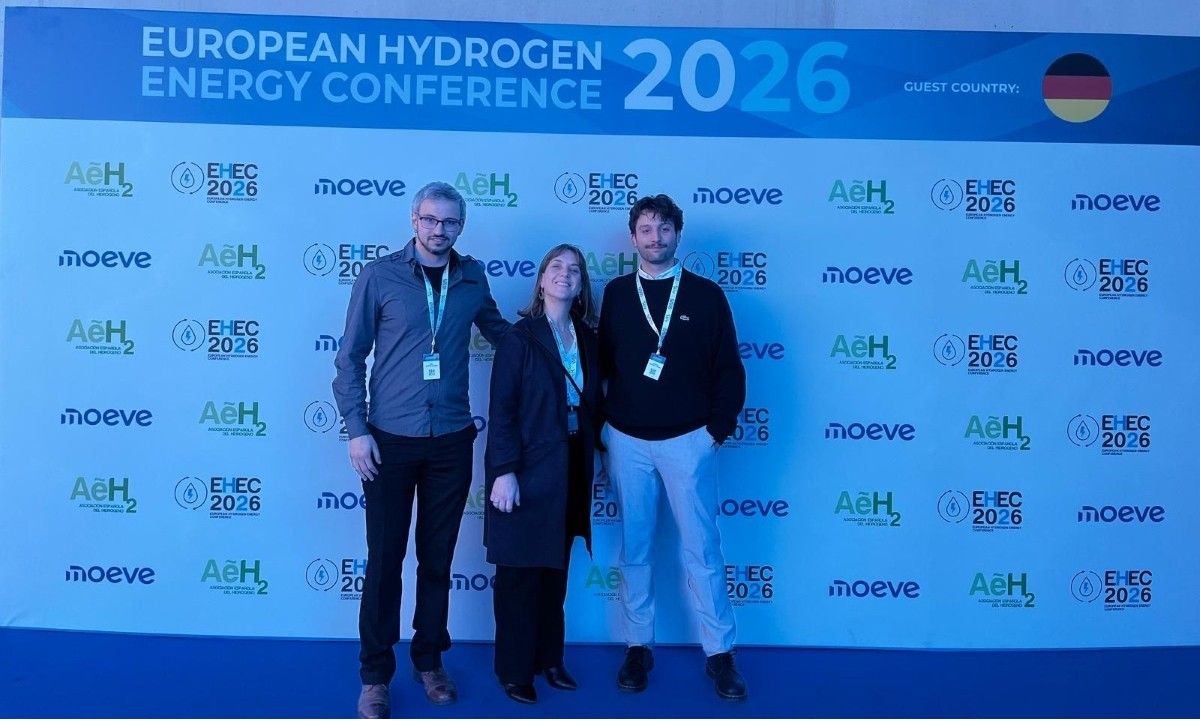
CIDAUT was actively present at the European Hydrogen Energy Conference 2026 (EHEC 2026), one of the most important international gatherings in the clean hydrogen sector, held in Seville, Spain, from 11 to 13 March. Our researchers contributed at two distinct levels of the conference programme, both at the strategic, cross-institutional arena and at the frontier of electrochemical modelling research.
The Event. EHEC 2026: Europe’s Premier Hydrogen Forum
Organised by the Spanish Hydrogen Association (AeH2), EHEC is Europe’s benchmark congress on hydrogen, bringing together the scientific community, industry leaders, policymakers, and investors from across the entire hydrogen value chain. The 2026 edition, held at the FIBES II convention centre in Seville, marked a milestone for the sector: the transition from strategic ambition to real project execution. The programme covered the full hydrogen value chain from green production via electrolysis and bioprocesses, to storage, distribution, mobility, and industrial applications, through four high-level plenary sessions, parallel technical tracks, and a structured B2B matchmaking programme. Side Events provided an additional space for focused, cross-institutional dialogue on strategic initiatives. EHEC 2026 arrives at a critical juncture: the industry is no longer debating whether hydrogen technology is mature, but how to accelerate its effective deployment to reinforce industrial competitiveness, energy security, and European autonomy in the clean energy transition.
CIDAUT Contributions. Two Voices for CIDAUT on the International Stage
Henar Olmedo represented CIDAUT at the Side Event of the Spanish Hydrogen Technology Platform (PTe H2), one of the most strategically significant events within the EHEC programme. This platform is widely recognised as a benchmark in Europe for public-private collaboration in hydrogen research, development, and innovation. Henar’s presentation addressed the nexus between Sustainable Aviation Fuels (SAF) and clean hydrogen, a topic of growing urgency as the aviation sector seeks credible pathways to decarbonisation. SAF produced via hydrogen-enabled routes, such as Power-to-Liquid and biorefinery-integrated processes, can reduce CO₂ emissions by up to 80% compared to conventional jet fuel, making hydrogen a key enabler for hard-to-abate aviation emissions.
At the core of the presentation was the work being developed within the Joint Working Group between the Clean Hydrogen Mission and the Biorefineries Mission: Hydrogen integration in biorefinery processes to produce SAF and chemicals, under Mission Innovation, the global initiative that brings together governments and research institutions committed to accelerating clean energy innovation. This WG represents a strategically important collaborative space where hydrogen and biorefinery communities join efforts to unlock next-generation SAF production pathways that are both technically viable and economically competitive. The outcomes of this collaboration are being consolidated into a high-quality review paper, which will be submitted to a special issue of the International Journal of Hydrogen Energy, further reinforcing the scientific and international relevance of the work.
Marcos Castrillo, researcher at CIDAUT, presented a technically ambitious and highly original piece of research in one of EHEC’s scientific parallel sessions: the development of a one-dimensional (1D), multiphysics and transient computational model for the simulation of Solid Oxide Electrolysis Cells (SOECs) at both single-cell and short-stack level. SOEC is considered a key technology for high-efficiency green hydrogen production, but their behaviour under dynamic operating conditions, especially when coupled with variable renewable energy sources, remains a major challenge. The model addresses this by integrating electrochemical, thermal, and fluid dynamic phenomena into a unified framework. This allows the simulation of both steady-state performance and transient processes, such as load variations and start-up or shut-down cycles, which are critical for real-world operation. By extending the approach from individual cells to short stacks, the work helps bridge the gap between fundamental cell behaviour and system-level design.
Overall, this modelling capability provides a powerful tool for virtual testing and optimization, helping reduce development costs and risks. It also strengthens CIDAUT’s position at the forefront of computational electrolysis research within the growing field of green hydrogen.
In addition, CIDAUT also contributed to the event through the presentation of a poster showcasing the progress of the AIHRE project: “Integration of biomass gasification and water electrolysis plants for renewable fuels production”, developed in collaboration with several project partners. This contribution provided an opportunity to share ongoing work on hydrogen-related technologies and to strengthen collaboration with other stakeholders in the field, highlighting the project’s role in advancing innovation within the hydrogen ecosystem.
A Commitment to the Hydrogen Transition
CIDAUT’s presence at EHEC 2026 reflects far more than attendance at an international congress. It represents the dual dimension that defines our approach to the hydrogen sector: rigorous scientific contribution on one hand, and active participation in the strategic dialogue that shapes European research and innovation policy on the other. In a sector that is rapidly moving from ambition to execution, CIDAUT is committed to remaining at the forefront, contributing the knowledge, tools, and international connections that Europe’s hydrogen transition demands.